 How-to
7 Wedding DJ Do Not Play List Mistakes to Avoid
Last Updated: November 18, 2026
Quick Summary
A wedding DJ do not play list is a written set of songs you forbid at your reception, and it protects the dance floor from tracks your crowd hates. Name the exact tracks and artists instead of vague bans like no slow songs, and pair every ban with a swap so your DJ always has a next track ready.
- Overplayed tracks like Celebration, Cha Cha Slide and YMCA appear on nearly every do-not-play list.
- Pair every banned song with a substitute that serves the same tempo, energy and crowd reaction.
- List gray-area songs as play only if the floor is full rather than outright bans.
- Guests may request songs through the DJ, with requests accepted until 30 minutes before the last dance.
- Send your DJ a written template covering must plays, do not plays, gray-area songs and clean versions.
Table of Contents
- Why a Do Not Play List Saves Your Dance Floor
- Classic Songs to Ban and Must Play Wedding Songs to Add
- How to Handle Guest Requests at Weddings Without Losing Control
- Use a Wedding DJ Song Request Template to Set Clear Rules
- Frequently Asked Questions
Why a Do Not Play List Saves Your Dance Floor
A wedding DJ do not play list is a written set of songs you forbid at your reception.
Most couples build a must-play list and skip the bans. Then a song with the wrong energy clears the floor in seconds.
Watch out: A vague ban like "no slow songs" gives your DJ nothing to work with. Name the exact tracks instead.
Classic Songs to Ban and Must Play Wedding Songs to Add
Some songs wear out their welcome; others fill a floor every time. Pair every ban with a swap so your DJ always has a next track ready.
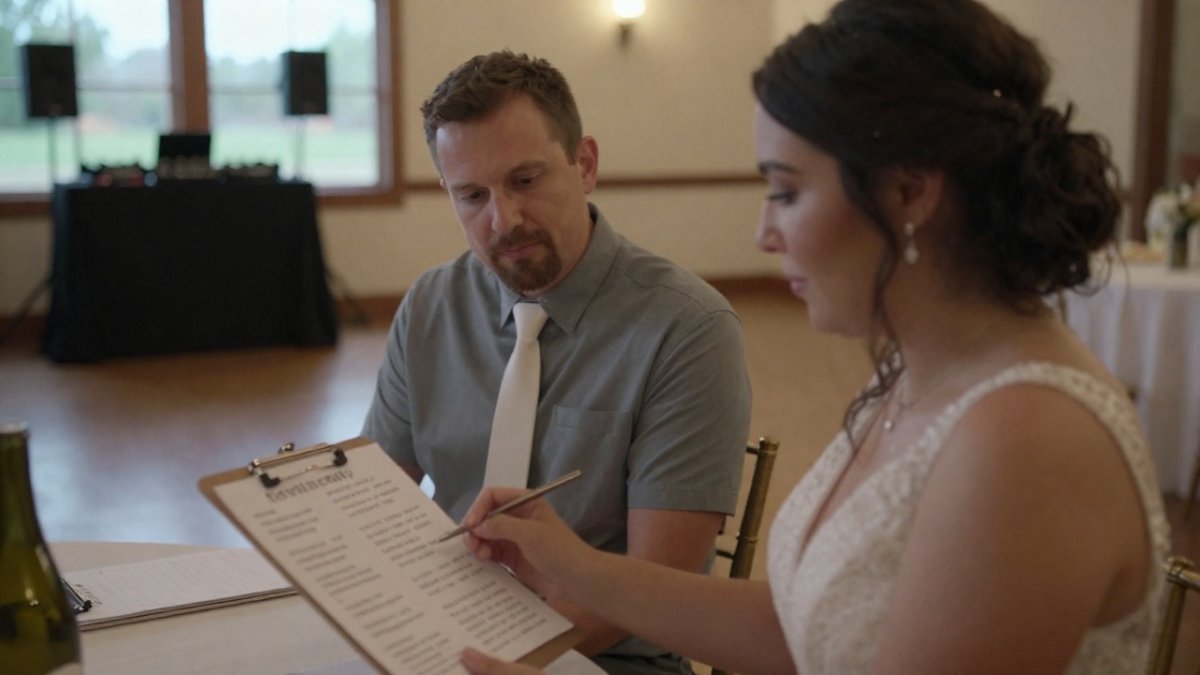
Overplayed tracks couples most often ban
These songs show up on nearly every do-not-play list, usually because guests have heard them at every wedding and party for a decade:
- "Celebration", Kool & the Gang
- "Cha Cha Slide", DJ Casper
- "Cupid Shuffle", Cupid
Don't ban a song your guests love just because you're tired of it. Before cutting "Sweet Caroline," ask whether your crowd skews toward the singalong age bracket.
Songs with lyrics that age badly
Some tracks were floor-fillers in their era but carry lyrics that read differently with grandparents and children in the room. Couples frequently flag:
- "Blurred Lines", Robin Thicke (frequent ban for family receptions)
- "Get Lucky", Daft Punk (usually fine, but check the edit)
- "Pumped Up Kicks", Foster the People (subject matter)
A clean edit often solves the problem. Confirm the version with your DJ before the event.
Must-play swaps that fill the same moment
Pair every ban with a substitute that serves the same purpose, same tempo, same energy, same crowd reaction:
| Song Type | Ban It When | Swap It With |
|---|---|---|
| Novelty party track | Your crowd skews older | "September", Earth, Wind & Fire |
| Explicit hip-hop | Kids and grandparents attend | A clean edit of the same hit, or "Uptown Funk", Mark Ronson ft. Bruno Mars |
| Long group dance | Your guest list is small | "Levitating", Dua Lipa or "Shut Up and Dance", Walk the Moon |
| Line dance | You want a modern floor | "Cupid Shuffle" replaced with "Wobble", V.I.C. (check the edit) |
| Slow ballad | You need a floor-filler | "Signed, Sealed, Delivered", Stevie Wonder |
The gray-area songs most lists miss
The tracks that actually wreck a reception are rarely the obvious clichés. They are the songs that are technically good but land at the wrong moment:
- A slow song dropped into a high-energy window. "Thinking Out Loud" is beautiful, but at 10:15 p.m. after four uptempo songs, it empties the floor.
- A genre shift that breaks momentum. "Wagon Wheel" can be a highlight for a country-leaning crowd and a floor-clearer for an urban one.
- A song with a long intro. Tracks with 30-plus seconds of build before the hook lose the room; your DJ should mix in at the chorus.
List these as "play only if the floor is full" rather than outright bans, so your DJ can read the room.
When family pressure collides with your list
A parent demanding a song on your do-not-play list is one of the most common reception conflicts. Handle it before the event, not at the microphone:
- Ask the parent to name the song and the moment they picture it in. Often the request is about a memory, not the track.
- Offer a swap that serves the same memory, a different song from the same era or artist.
- If the song stays banned, tell your DJ in writing so they can absorb the request politely.
How to Handle Guest Requests at Weddings Without Losing Control
Guest requests can rescue a dance floor or wreck your plan. The outcome depends on the rules you set before the night.
Set a written request policy before the event
Give your DJ a clear policy in the same document as your do-not-play list. A policy that works well for most receptions:
- Guests may request songs through the DJ, not the microphone or the couple.
- The DJ plays a request only if it fits the approved genres and does not appear on the do-not-play list.
- Requests are accepted until a cutoff time, commonly 30 minutes before the last dance.
Let your DJ protect the vibe so you never have to play bad cop.
A script your DJ can use to decline a request
A short, warm refusal keeps the guest happy and the floor intact. A script like this works:
"Great pick, that one's actually on the couple's do-not-play list, so I can't spin it tonight. But I've got something in that same lane coming up. What's your name? I'll give you a shout-out when it drops."
The shout-out gives the guest a moment of recognition without handing them the aux cord.
The must-play versus do-not-play conflict
The hardest request is the one where a guest, often a parent, demands a song on your do-not-play list. Handle it in three steps:
- Confirm the conflict in writing before the event. Ask your DJ to flag any must-play song that also appears on the ban list.
- Decide the exception in advance. If you want to honor the request, carve out one slot, for example, a single song during the parent dance block, rather than opening the whole list.
- Give the DJ a fallback line. If the guest pushes at the event, the DJ can say the couple reserved that song for a specific moment and it is already queued.
Watch out: If you tell your DJ "use your judgment" on conflicts, you have handed the decision to the person with the least context about your family. Decide the exception yourself, in writing.
Gray-area requests and how to route them
Some requests are neither must-play nor banned, fine in the right moment, deadly in the wrong one. Give your DJ a third category, "play only if the floor is full."
- A slow song requested during a high-energy block goes to the gray-area list, not the queue.
- A genre outside your approved mix goes to the gray-area list unless the floor is already packed.
- A song with a long intro goes to the gray-area list unless the DJ can mix in at the hook.
This keeps guest interaction warm without handing over control of the night.
When to make an exception
Exceptions are fine when they serve the room rather than the requester. A request that gets 20 guests on their feet is doing the DJ's job; one that clears the floor is not. If you'd rather have the dance floor, the request goes to the gray-area list, and your DJ has the script to say so kindly.
Use a Wedding DJ Song Request Template to Set Clear Rules
A wedding DJ song request template turns scattered texts into one clean document. Fill it in once, send it early, and confirm it in person.
Copy this template and send it to your DJ:
Wedding DJ Song Request Template
- Must play (first dance, parent dances, three floor-fillers):
- Do not play (exact song titles and artists):
- Gray area songs (play only if the floor is full):
- Genres to avoid:
- Clean versions required? Yes / No
- Guest request policy:
- Songs for dinner, cocktail hour, and dancing:
- MC announcements we want (keep minimal):
Walk through the template together before the event, and ask your DJ to read the bans back to you.
A do not play list only works when it reaches the booth in writing and gets confirmed out loud. Joyful Jamz Entertainment builds every reception around your personal taste, with a dedicated, heartfelt approach and real attention to the details you care about.
Frequently Asked Questions
What are good do not play songs for a wedding?
Start with songs you personally dislike, then add tracks with inappropriate lyrics for a mixed-age crowd and overplayed hits that empty your dance floor. Common picks include novelty party songs and anything tied to a bad memory. Keep the list to 10-20 songs so your DJ still has room to read the room and adjust. Share your must play wedding songs alongside it so your DJ knows what to reach for instead.
How do I communicate my do not play list to my wedding DJ?
Send your list in writing at least two weeks before the event, then confirm it on a call. Use a wedding dj song request template that separates must plays, do not plays, and gray-area songs your DJ can use judgment on. Ask your DJ to read the list back to you so nothing gets lost.
What if a guest requests a song that is on my do not play list?
Tell your DJ in advance how to respond. The standard approach is a polite decline: the DJ says the couple has reserved that song and offers a similar alternative from the approved list. This keeps guest interaction positive without breaking your rules. Give your DJ two or three backup crowd pleasers so a declined request turns into a song people actually dance to.
